Showing posts with label music. Show all posts

Monday, March 09, 2009

Midlake - The Trials Of Van Occupanther

I've been listening to Midlake's second album The Trials Of Van Occupanther for months now, to the exclusion of just about anything else (other albums, food, basic hygiene). Let me say right away that the album is jaw-droppingly brilliant, like a smooth hit of a new drug. So notice is duly given that this post is less a considered appreciation full of learned comparison and cool analysis, and more a dribbling fan letter. Apologies are offered.

Trials is the Texan band's second album after the less-than-overwhelming Bamnan and Slivercock. That album’s name alone had suggested an overweening commitment to the whimsical, an impression the music confirms, its studied psychedelia getting pretty tired over the course of an album. Lazy comparisons to The Flaming Lips were thrown around by critics; but lazy Flaming Lips is closer to the mark: Bamnan is free from the emotional punch of peak Lips. But there are some faint presentiments of the story-telling ability that lifts Trials free of the pack.

It's clear from the first track that the band have undergone a collective Great Leap Forward. The music has moved into a kind of turbo-charged combination of AM rock and recondite folk, the vocals now stacked and smeared like classic folk rock. From their studied rustic image (few moderns bands can pull off being so comprehensively bearded) to the fact that all of Midlake sing, their voices interweaving around serpentine melodies and thrilling harmonies. Listen to the track Branches and the LA version of Radiohead's I Will; each song stacks it harmonies like a madrigal.

But it's the lyrics that set the album apart. Something is not quite right in the rural idyll of the titular Van Occupanther. His ruritanian community seems to be facing an impending, possibly ecological, catastrophe. In fact, this disaster may have already occurred, leaving Van Occupanther the only survivor – a fact that he is either unaware or in denial of (see also the Martin Amis story “The Immortals” from Einstein’s Monsters.)

While the sound may be a souped-up folk-rock, ringing many familiar bells, the lyrics touch on none of the American mythos of, say, Dylan or The Band. Trials is connected to the Americana tradition only in the most oblique or occluded sense.

Check out the central lyrics to the slashing, urgent Roscoe (which also happens to be the best song I’ve heard this year):

The village used to be all one really needs
That's filled with hundreds and hundreds of
Chemicals that mostly surround you
You wish to flee but it's not like you
So listen to me, listen to me

Oh, oh, oh and when the morning comes,
We will step outside
We will not find another man inside
We like the newness, the newness of all
That has grown in our garden soaking for so long

Whenever I was a child I wondered what if my name had changed into something more productive like Roscoe
Been born in 1891
Waiting with my Aunt Rosaline
These lyrics have a sinuous and insinuating melody, and the chorus is defined more by its sudden vandal slashes of guitar than by its structural position. There are plenty of other equally good songs. 'Young Bride' is a ruritanian stomp - the wonderful video shows the protagonist escaping from her stifling family life to a snowy fantasia of 'frozen lakes, snowshoes and hunters'. The title track is a hopeful mantra, only varying at the very end. The final track is 'Head Home', where the sense that they've channelled the spirits of Fleetwood Mac is strongest. The harmonies glisten and the guitar solos are fuzzily wonky. And check out the lyrics:

Bring me a day full of honest work and a roof that never leaks
I'll be satisfied
Bring me the news all about the town
How it struggles to help all the farmers out during harvest time

But there's someone I'd like to see
She never mentions a word to me
She reads Leviathan
The music and massed swell of voices drops out on that final line - what it means is beyond me: is the reference to Hobbe's manifesto about the need for a strong man to lead significant? Search me. The line is immediately followed by the key line: "Think I'll head home".

Album of the year so far…

Tuesday, March 03, 2009

Kanye Baby!


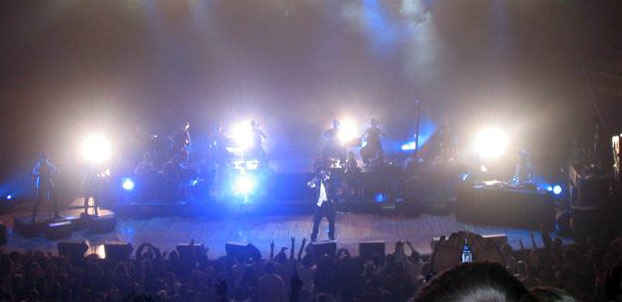
Everyone's favourite rapper Mr Kanye West was at the Opera House on Sunday night; or, to put it more accurately, Mr Utzon's vast but vanilla interiors were transformed by a glittering riot of fedoras, sharp white suits, feathered hats, shades; the whole place was like a demented Hype Williams video. (And to think I'd chosen the Mahler and Mozart double-header to get loaded. What was I thinking?)

So anyway, I went down thanks to a handy invite from the lovely people at Universal records, and took my seat among the seats reserved for the industry. I know this, because we were just about the only people who don't shake our collective tail-feathers the moment the beats begin. Too cool for school, I suppose, which is a shame because I wanted to GET UP ON IT.

After a small eternity, things started to happen. A dozen elegant string players from the Sydney Symphony took their seats in the bleachers, led by woman in white who was later introduced as Kanye's musical director. She played like a demon and, when not fiddling up a storm, spent the rest of her time exhorting the crowd to lose it. With a line-up rounded off by turntablist extraordinaire DJ A-Track, and two superb backing singers who provide all the vocal samples, the sounds was as rich and deep as any hip hop show could be.

After a tantalising overture of Diamonds Are Forever, Kanye himself appeared in white-rimmed shades, black gloves, and a neckerchief mask, looking like a Hamas Michael Jackson. The sound started out muddy, the strings and rhymes submerged beneath the awesome bottom end. But after that, everything was frikkin' amazing...

Some highlights: Gold Digger. The DJ begun this with the barrel house blues of the original Ray Charles track - but no-one was fooled; and no-one remained seated, especially after those heavyweight quarter beats at the start were teasingly elongated over four machine gun bars before the rasping clavichord melody kicked in. (At least I think it's a clavichord... Similar to Superstition...Answers on a postcard)

The string medley of Bittersweet Symphony and Eleanor Rigby. Delicious...

Jesus Walks. This song is already tre intense, but this time the string section ratcheted up the tension, providing the staccato stabs of the original.

Roses. I swear to God: EVERYONE knew every single word. There's something surreal about being in the Opera House and hearing thousands of people chanting "Bitch, are you smoking reefer?" Something very cool about it too. See also: the bit when everyone growled along with "My grandfather trying to pull it together. He's strong".

Kanye's between-track chatter is both jaw-droppingly boastful and winningly cheeky. He plays a few verses from a bunch of his own productions - Jay-Z, Ludacris, etc - and then says "I did these. You thought I was just about the tunes? These are MY beats!" And how's this for ego: "I don't really know how to say this.... but I'm a big deal". Cue deafening applause.

Gone. Another chance for the string section to show their chops.

And not forgetting the section in the middle where he played along with some classic tunes. First up was Al Green's Let's Stay Together, followed by Rock With You by Michael Jackson. The third track...? In fact, it was Take On Me by A-Ha, complete with Kanye dancing about like a happy tool, and the DJ dropping out the beats for the ecstatic crowd to provide the chorus.

"They said I couldn't bring hip hop to the Opera House".

Boy, were they wrong.


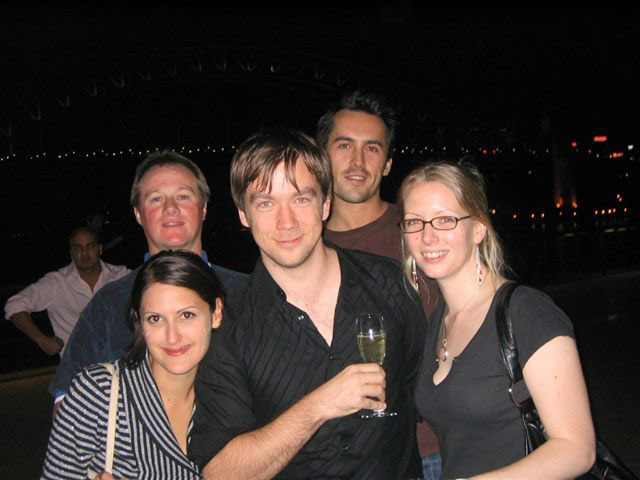
Finally, here's me and the peeps from Universal and iTunes:

Sunday, February 22, 2009

Review: U2 - No Line On The Horizon (2009)

An orthodoxy of sorts seems to have hardened among decent right-thinking folk about U2: let's call it the Pop paradigm (wait! Come back!) According to this view, 1997's Pop was a grotesque overreaching attempt to stay relevant, overblown in some places, half-finished in others. Was that an attempt at a techno song? "Discoteque": huh? This isn't the U2 we know and love. Pop has gone down in U2's history as the Tap--like turd full stopping the ironic carnival that started with Achtung Baby! and which gifted us such steadily diminishing returns as Zooropa and, heaven help us, Passengers. Too many giant lemons, not enough joshua trees. That this critical trashing was merrily aided and abetted by the band themselves, eager to tell anyone who'd listen how the album had to be rushed to market so that they could get on the road for the Popmart Tour and how everything in future would be Back to Basics, yes indeed. The job of best rock band in the world is vacant, said a penitent Bono, and we're reapplying. Their reputation was only fully rehabilitated with the triumphant All That You Can't Leave Behind and confirmed with How To Dismantle an Atomic Bomb. So goes the orthodoxy.

Of course, the trouble with orthodoxies is that they're too often balls. Pop is perhaps my favourite U2 album, the subsequent two albums being, to these ears, all but unlistenable (not least because the very best songs have been played to death on TV and adverts)*. Pop came out the same year as albums like OK Computer, Ladies and Gentleman We Are Floating In Space  and, um, sundry other great records (OK, alright: I was referring to Attack of the Grey Lantern). I was working in a Virgin Megastore at the time, and would often play them over the PA (somehow, all that great music is inextricably linked in my memory with the comet that was visible throughout that summer.) Pop has some of their best songs: "Please", "Gone" (which comes with a very atypical Bono chorus: "Goodbye/You can keep your suit of lights/I'll be up with the sun/I'm not coming down": Bobbie Gillepsie would have been proud), "Wake Up Dead Man", "Discoteque", "Mofo". That some of the songs on Pop are somewhat sparse works in the record's favour: where the band's subsequent output tends towards bloated maximalism, all the joy and spontaneity crushed ruthlessly from the songs by an obsessive working and reworking, Pop's best songs sound conjured from thin air, alchemised by four guys who go way back just playing in a room. 

The last two records... actually I can't remember a great deal about the last two records, since I listened to them all the way through only a handful of times. They certainly seemed horrible: not an ounce of wit or playfulness, too many chants written explicitly for the stadium (don't U2 at their best sound like they're playing just for you, not a stadium; even if that is, in fact, what they're doing?) But precisely because I owe this damn band an enormous (yes) debt of gratitude, I imagine I'll always have to listen to whatever they put out between here and the day they stop. And so here's No Line On The Horizon. Are they redeemed?

Yes. More or less. This album has the band's best songs since Pop, even if there are a couple of now-obligatory mid-tempo clunkers. The lyrics stay mostly on the right side of embarrassing, Bono's still in fine voice, the songs about Africa are happily absent, the production from Lanois and Eno (listed as band members in the sleeve notes) is frequently amazing. The title track is a mysterious swamp of guitars and bass, Kings of Leon by way of the Glistening Chimes of Eno.** "Magnificent", despite its hostage-to-fortune title, is a triumph, actually, with a piping little keyboard hook in the chorus that's just swell; "Moment of Surrender" has some lovely unexpected  chords; "Stand-up Comedy" is blithely self-referential and "Unknown Caller"'s chorus is nicely odd. 

The best songs come last. "Fez" swirls coquettishly before deploying the big Edge chords, the single let's just say it at least makes sense on the album, and "Cedars of Lebanon" is another downbeat album closer much in the mold of "Love Is Blindness". So. If U2 are never quite going to get back to the restless spirit that created "Hold Me Thrill Me Kiss Me Kill Me" or "Lemon" or "Numb" or Zooropa's title track, then so be it. But this'll do.


*Though it's worth noting here that the band's tendency, since at least All That You Can't Leave Behind and the Best Ofs, for offensive clipping and too much loudness. I suspect that this album is no different: there are a number of songs where what should be the thrilling in-rush of Edge's guitar sounds no louder than what went before. You know you're in trouble when a supposedly quiet verse with no guitar is no quieter than the subsequent verse with guitar. Try "Until The End of the World" for an example of sane mastering: when Edge's guitar solo comes in, it sounds like the song suddenly enters a fourth dimension.

** Can someone call a band that please?

Friday, March 21, 2008

The Rest is Noise

I've been waiting for The Rest is Noise by Alex Ross, music critic for the The New Yorker, for at least a year. I finally got my hands on a copy a week ago, and it's magisterial, a wonderful, heady sweep of a century's music and how it effected, and was effected by, political events.

His site has an extensive range of samples which accompany the text, which makes the whole experience vastly richer.

But I have to say, I couldn't resist the temptation to trigger them all at once and turn up the speakers.

You try...

Cloud-Busting

Enormous Yes yields to no man or woman in its love for Kate Bush. When the Yes was but a callow nipper making its way in a big bad world, her song Cloudbusting nestled and shone amid the drek like a tiara in a toilet.

"I still dream of Orgonon," she sang, and we wondered what on earth Orgonon might be, before being distracted by the mmmmmmm knowing something good is gonna happen bit.

So: what was it? And why were the Government interested?

Listen.....

Thursday, March 20, 2008

The Rip | Portishead | Third

This is the only song I can listen to at the moment. I should stop, I’m going to wear it out. But I just can’t. It’s a beautiful and creaky guitar figure, a four-note arpeggio shape entwined around a lovely long chord structure; a similar hushed but hopeful vibe to the Out Of Season album. And then it’s insistent and electronic, synths erasing the guitar: but still those same ever-cycling notes; and over it all, and within it, like a ghost, Beth, keening, mournful. It's a wonderful song on an album full of wonders.

Worth the wait and then some.

Friday, February 22, 2008

The Brits: never again

The Brits. Honestly, why do I still watch this, when I could be doing something more spiritually nourishing, like punching myself in the face? It must be some notion that I still have, somewhere deep inside, that pop can still thrill, move, delight and transport. On the evidence of this parade of mediocrities, I must be wrong.

It’s been easy the last five years, since Australia doesn’t show the Brits. They have the ARIAs which, despite being on a much smaller scale and having a worrying tendency to give multiple awards to Missy Higgins, at least has no global aspirations. Every second of this year’s ceremony scream the organizers desperation to be cool and edgy. And then they tell us that the award for Best British Live Band has been voted for by listeners to Radio 2. Fine and rounded citizens though I’m sure they are, Radio 2 listeners perhaps aren’t representative of those gig-goers who’ll happily be doused in the guitarist’s coke-adulterated sweat just to catch a possibly seminal event, or at least a rousing one. Sure enough, Take That get the award. Fine. They’re not the problem.

Sharon Osbourne. Britain, why?

The Brits School. Half the winners gave shout-outs to the kids in the front rows, which were deservingly stuffed with current students. What is the Brits School? Is this the future of British music we have to look forward to? Seems the only achievement of note is its ability to teach its students the perfect glottal stop. And what’s with Adele? Her song is OK, pretty good even. But are we that desperate for more Amy that we’re going to canonize a singer who, on the evidence of her segment of the Mark Ronson medley, seemed to have wandered in off the street?

Talking of Winehouse, she was literally the only good bit. Happily, she got two bites at the cherry. She couldn’t stand still and looked hugely nervous, like it was her first time on stage: skirt hitching, hair-twiddling, hopping around like a kid. But the voice: like she’d been singing for a hundred years. There was something thrilling about “Valerie”, as she seemed to be stunt-singing her way around the melody, without ever looking like she was about to crash. Adele, Kate, Leona et al can only dream.

But it says something that the best bit of the evening was a medley of old songs. The only other good thing, apart from Amy and the end, was that I missed Mika opening the show with his “Grace Kelly”.

Gutted.

Wednesday, February 13, 2008

Henry Plainview | Jonny Greenwood, OST There Will Be Blood


This epic fragment occurs right at the beginning of There Will Be Blood, as the light comes up on hills that may or may not contain oil. It's a precise musical analogy for Plainview's single-mindedness, as all the strings discordantly make their way to the same piercing note. It's terrifyingly loud, truly hair-raising, and a reminder of what an original musical language can do for a film, akin to the moment our old TV almost freaked out when the mothership starts singing in Close Encounters. Also astonishing is "Open Spaces", with its long unworldly notes and ondes martenots. Just a shame the soundtrack doesn't have any fragments of dialogue: be great to have "I drink your milkshake! I drink it dry!". Make a great ringtone...

Sunday, February 10, 2008

Radiohead : In Rainbows

I've been meaning to write about In Rainbows since its release a few months back. About how it's a record of a band on its best form. About how friends who previously would have rushed to get the measure of a new Radiohead record now seemed laissez-fare or outright hostile about In Rainbows, suspecting that it might continue where the unfinished sprawl of Hail To The Thief or the electro-jazzery of Kid A or Amnesiac left off. But also about how three or four of the songs on In Rainbows are the best the band have released. About how the record soundtracked my leaving of Australia.

But this guy said most of it, and said it better, so with apologies, read this instead:

"...all that mattered were 10 beautiful songs, some of the best of the band's career, that felt so expansive, so breathtaking, that Radiohead could've delivered them via USB wristband or some other such nonsense and I still would've gotten that scalp-tingle of joy that rushes through my head when art touches my heart.

The excitement of witnessing a great band hit a peak is a timeless thrill. To hear the strummed, magnificent hook of "Bodysnatchers" flapping like a seagull in flight as Thom Yorke screams to the world, "It is the 21st century! It is the 21st century!" is as awesome an experience as watching Kurt Cobain leap into a drum kit or Joanna Newsom's fingers drift across a harp. The trebled, drunken breakbeat that kicks off "15 Step" sounds so lo-fi that at first you think, "Oh, great, this download sounds like shit. I paid $22 for this?" But it's a ruse: When Colin Greenwood's hard, dub-heavy bass powers in alongside Jonny Greenwood's loopy guitar line, the song expands, the beat becomes tethered, and speculation on the what of In Rainbows seems as unanswerable as the why of this here vista.

The best songs on In Rainbows travel many melodic roads simultaneously: Big basslines skulk alongside meandering harmonies, drifting piano tones, and deep, unassuming ambient rumbles that subtly steer you along like a rudder on an ocean liner. Point A will no doubt lead to Point B in a Radiohead song—this isn't the Fiery Furnaces we're talking about—but the pleasure is in hearing how these five dudes who've been playing together for 20 years get there. On "Reckoner," the band stays tight for most of the song as though squeezed into a cubicle, but then—boom—the walls collapse, and we're in the great, wide open with an eerie, pastoral string section.

Granted, most of the time I have no idea what Thom Yorke is talking about: Usually it's a variation on "Help, I've fallen and I can't get up." No lyrics he's ever written have floored me like, say, the first statement-of-purpose couplet on P.J. Harvey's White Chalk: "As soon as I'm left alone/The devil wanders into my soul." In most of Yorke's lyrics, lines dangle, drift, are abandoned. Is the "elephant in the room" of "Faust Arp"—the one that's "tumbling, tumbling, tumbling in duplicate and triplicate"—the same creature that a few lines later is "dead from the neck up"? How can a single elephant tumble in duplicate and triplicate? Or is this lyrical cubism? And I can't imagine another lyricist getting away with opening a song on one of the most critically acclaimed albums of the year with the line "Wakey wakey, rise and shine." The only Rainbows lyric that really tracks is "I have no idea what I am talking about," and it's best to take Yorke at his word and appreciate the beauty of his voice, which sustains itself like a patient bow drawn slowly across a cello. Regardless of what he's saying, Yorke conveys a profound sense of wonder and love.

Love. My friend Paul B. Davis, part of the art collective Beige, has posited that the relationship between humans and data is evolving, and that real-world emotions now figure into once-clinical computer interactions. He calls this movement Post-Data, and its aesthetic goal, he writes, is "gaining suffrage for microprocessors . . . data, in its cold and inherently meaningless incarnation, is over. Post-Data is all about feelings, and unconditional love for the bits. The Post-Data artist has an emotional attachment to the data process so strong that it's not right to just call it 'data' anymore . . . Post-Data gives you the faith to sit down, take a look at your computer, and say, 'I love you.' "

Maybe that's what In Rainbows made us feel—a rush of unexplainable emotion, a digital crush, a confirmation that things aren't like they used to be, that 2007 was a watershed that'd been building for the past decade but had yet to manifest itself fully. It felt to me like what Sam Phillips captured so eloquently in the first of Peter Guralnick's Elvis Presley biographies, Last Train to Memphis: "I was shooting for that damn row that hadn't been plowed," he explained of his quest for the King. Radiohead's 2007 felt like a similar shot: some sort of convergence that you just knew was coming, but exactly how it would arrive was still fuzzy. Now, some semblance of clarity has emerged—right?—and hearing the bundle sing from trunk-lid speakers, my head filled to the brim with Yorke's "Videotape" benediction ("No matter what happens now/You shouldn't be afraid/Because I know today has been the most perfect day I've ever seen") while a campfire spread analog warmth on my analog face, the future felt remarkably like the past: intense, full of mystery and meaning, thrilling, lovely."

Friday, January 25, 2008

Burial - 'Archangel'

I've returned from some five years in the wilderness (Australia since you ask), fetching up in the sunlit uplands of the UK. After travelling for a couple of months in China and Japan, we arrived in London in the middle of the one the coldest snaps I can remember (or maybe it's always been that cold in Winter, and I had somehow forgotten).

Since then, I've been working in Paddington, walking the streets, a grimy mixture of dirty main roads and gleaming canal-side developments. And this Burial track, which I'm sure has been written about to death elsewhere, has been the perfect accompaniment. It's an urban masterpiece, the sound of disembodiment, of ghosts howling in the machine.

Sunday, November 25, 2007

Underworld: Oblivion Ball


I owe Underworld a great deal. If it hadn't've been for Dubnobasswithmyheadman taking residence on my stereo and in my head during my first year of Uni, I'd probably still be listening to... well, I shudder to think. Maybe I'd be of the opinion that Kaiser Chiefs represented British rock at its mercurial best? Or that James Blunt was a sensitive and engaging artiste with a voice like old honey, rather than an unutterable ballsak with a voice like gagging on sick. Who's to say? I do know that, before Underworld, and with only a few honorary precursors (The Shamen, The Orb), the music I liked had to have choruses, guitars, drums; the indie litany, all present and correct.

But Dubnosbass was a passport to a quite different sonic dimension (having already turned down The Prodigy's earlier and (then) less appealing promise to take my brain to said other dimension): not only was it a thunderous and beguiling album in its own right, it was as if someone had just turned the colour on. Suddenly, I got the point of beats, could see the possibilities of 4/4; realised that I'd be listening to music like this from then on.

So when we learned we could combine our trip to Japan with a chance to see Underworld, Andrew Weatherall, Simian Mobile Disco and a couple of locals acts, we were cock-a-hoop (which turned to ecstasy-on-toast when we managed to get tickets to see Daft Punk in Kobe). On the other hand, their most recent album, Oblivion With Bells, sounded a bit vanilla on the few, admittedly not close, listens I8d given it. Were the band finally reaching the end of their productive span after the better part of 20 years?

Tish and nonsense. On the evidence of last night's gig in the cavernous Makuhari Messe in Tokyo (easily sold-out), Underworld are, if anything, at the peak of their powers. They played a truly mammoth set of crowd-pleasers, roof-raisers and floor-shakers and had the crowd of 20,000 staggeringly stylish Japanese and two not-quite-so stylish-thank-you-very-much westerners reaching a state the Buddhists call satori but I call ohmygodthatwasAMAZING. Samurai dancing, beat bushido: whatever it was, we were going off. A song like Rowla, for instance, became a frightening acid squall; a frankly barbaric King Of Snake was divine, unending; even the new songs seemed little short of perfect. From

They hit us with the ever-circling beat-storm of Pearl's Girl, and followed it with a euphoric Two Months Off. Ahh those synths. I wanted it all to stop. I never wanted it to stop. They finished with Moaner, a song I'd never really come to terms with in the past; and yet, in the context, it was spell-binding, Karl Hyde throwing Elvis poses in his glittering silver jacket, ranting in the purple spotlight like the scary but lovable cockney loon we know him to be. Toss in a towering Cowgirl and a delirious Born Slippy, and you've got the mother and father of all live shows. Shock and awe doesn't cover it.

They play an encore of Jumbo, the blissful synths and gaseous pads a relief from the frenzy of the last two+ hours, and we walked (!) back to our hotel to some dubstep from Weatherall, before losing consciousness at around 4am.

There's no WAY that Daft Punk can top that. Right?

::::::::::::::::::::::::::

Apologies for having been away so very long. Since we've A) packed up our entire lives and left Australia, B) spent a rather crazed month traveling in China and C) found ourselves in the middle of Japan, updating this blog has been both tricky AND hard. As the ad very nearly says, Impossible Is Something.

Oh yes, and D). I lost my iPod. 80gbs worth of music down the wazoo, just like that. So, apart from Radiohead's album, I've had very little new music to listen to. And yet, apart from the embarrassment and anger of losing such a valuable piece of hardware (and a birthday present to boot), I don't feel too bad. It means I can start all over again. I will only upload albums that I WILL listen to.

This is my pledge, and I will keep it. Definitely.

:::::::::::::::::::

The man Barrie on McCarthy's frighteningly good The Road. Nothing to add really, except to say that Blood Meridian is in my top five books EVAH ("What are the others?" I'm not telling**), not least because I could reliably freak Shana out by reading aloud from its blood-soaked pages (not literally blood-soaked, I hope you understand. That would be weird), especially the first Indian attack, the poor horse bitten on the face by a snake, and the final hallucinatory scenes with the Judge and the Kid.

*Though, to be fair, I only got hold of it in my last couple of weeks in Australia, when finding time to give albums the Deep Listen was far from easy.

** " Cos you don't know", etc.

Thursday, July 12, 2007

Bat For Lashes

I absolutely hate it when this happens. I got the Bat For Lashes album Fur and Gold a good six months ago. Yet for some reason, I only listened to it last week. Actually, I know why. Too much music. Too many new albums, too many old albums, too many mixes, too many MP3s, too many damn podcasts. Make it stop. Except you don't want it to stop, because you might miss an album like this.

I think the problem must have been the initial reviews damned it with faint praise: "Bjork-lite", "Batty by name, batty by nature", "weird". I should have known then that this was laziness of the first order (I've never been lazy when it comes to describing music, no sir, no way). It's true up to a point that singer Natasha Khan has a singing timbre not a million miles from Bjork's - but to compare to Bjork suggests a similarity of styles that really isn't there most of the time (especially not in later Bjork).

What is similar is a sense of listening to something both precious and mysterious, full of meaning that can't quite be grasped. "Creatures of mercy/Shoot them down, set me free," sings Khan with the kind of conviction that Bjork brought to songs like "Isabelle" and, especially, "Pagan Poetry". And "Tahiti" has the same crystalline beauty of Vespertine's best songs. But mostly I'm hearing the magic and sensuality of Kate Bush. In other places, there's a similarity to Goldfrapp's first album; plush and romantic, full of harpsichords and plucked strings, sinuous Theremins and harmonies, kettle drums, spoken word interludes.

Either way, the album is like stepping into the kind of dream I would have when I was young, full of forests and wolves and hunters and danger.

Tuesday, June 19, 2007

Âme : “Enoi"

Now this is fucking blistering, and I don't use the bad word lightly. What a simple idea. Take a techno track with scattered vocal fragments rippling through the hi-gloss fabric: "Wish", "eeeh" etc; take various frenzied clankings and spastik sound events and gothik synths and peculiar chants, then build up the beats and the bass-spring and the intensity, and then, just when it's really ticking, introduce us to the cry of the alien tripods from War of the Worlds, like a psychotic fog-horn. Scared the willies out of me the first time. And then every other time too. The A-Side, Balandine, is equally unhinged, a vicious bass-riff being submerged beneath hard Detroit beats.

Frenzied, epic, orchestral, this is techno at its best.

Monday, June 18, 2007

Chemical Brothers - We Are The Night

In which the Chemical Brothers continue their ineluctable slide toward the awful. I've given it a few tries now, and the question keeps coming up: when and why would I listen to this? When it's sonically affecting (which is not often), I still can't help wonder what I could be listening to that would deliver the same payoff at least twice as hard. The beats used to fun or hard or dirty or some thrilling combination of the three; now they mostly just sit there. The psychedelia, already largely in retreat with Push The Button, has all but disappeared, and the songs just aren't memorable enough.

The title track never gets going, the Midlake track is banal, and I never want to hear the nonsense with Willy Mason or god help us the Klaxons again. Easily the most enjoyable track is The Salmon Song with Fatlip, and that's the one that sounds least like the Chems. Maybe I need to listen a few more times. It's just that right now, doing that sounds like a chore; something I never thought I'd be saying about a Chems album.

The horror, the horror

There comes a time when the running must stop, when one must confront the very thing from which one flees. To drain the poison, to exorcise the demon. Otherwise, that which you've tried to erase will always be there at the threshold of consciousness, leering and gibbering like a maniac.

All of which is by way of saying that The Travelling Wilburys albums have been re-released. Well, I'm not afraid any more. I'm going to look my demon square in the face and say "You can't beat me, Lord Baal!" And at that point, my psychic wounds will heal and I will be accepted with love into a balmy sunlit world of joy and grace.

Forgive the saturnalia of sarcasm, but the Wilburys first album also happens to be the first album I really loved, with the possible exception of Cloud Nine by George Harrison. In a time before U2, or The Cure, or any number of later obsessions, I listened to Volume 1 hundreds of times. It struck me as the very acme of what music could do.

"Handle Me With Care". Yes! Handle me with care - such prescience! Handle me with care, lest I crumple beneath the combined weight of your breezy youthless genius. "Tweeter and the Monkey-Man". It turns out that Bob Dylan had recorded plenty of albums and songs before this, and that some of these were, and still are, thought to be good. Am I ashamed to admit that "Tweeter" was the first Bob Dylan song I ever loved? Yes; but there it is.

On the other hand, I've no intention of re-listening to either record. What if the healing rays of musical hope turn out to be mere overpolished session rock, with all the fragrant charm of an o'er-brimming chamberpot? No, I'll just have to stay repressed, to keep that little scaley demon fellow fed and watered and hopefully becalmed. Otherwise, I’m likely to find myself posting on the genius of George Michael's "Jesus to a Child".

That way damnation lies.

Wednesday, May 23, 2007

The Field - From Here We Go Sublime

Is this the sort of record you give to someone who professes to hate techno, or is it exactly the kind of record they would hate? Dunno. But I love it. The simple drum patterns, the micro-snatches of pop songs you can't quite recognise, chopped up and then streched across the airy synth dronescape like so many deliquesent clocks. "Kappsta", which was on Kompakt's Pop Ambient 2007 collection, is eerily gorgeous, a balletic glide through the upper atmosphere of some billowing gas giant, and is a good place to hear the basic trick in action, which involves endlessly delaying the chord changes so that when they come they're sudden rays of sunlight. "Everyday" is monstrous, building (or should that be tunnelling?) into a furious chant.

It's true that the record shares more than a little DNA with trance. But then, trance never had this monumental and geometric beauty before, constructed of interlocking planes of sound.

Plus, "On The Ice" samples Kate Bush, so it must be good, right?

Friday, March 30, 2007

A personal history of Levitation. Part 1

Hands up who remembers Levitation? Exactly. They were one of those early nineties bands, not even as popular as Cud, Kingmaker or Carter USM; and now all but forgotten. They released a couple of EPs and a less than successful album. Diminishing returns set in quickly. The singer left, the band struggled on; over and out. And yet. This was a band I'd loved with an intensity I've rarely managed subsequently, a sound-track to a brief phase hallucinogenic adventure; a band that, unlike previous obsessions like REM or The Cure, I can still listen to now and hear fresh things, detect in their quicksilver sound the seeds that grew into a later love for Radiohead, say, or Talk Talk, or Krautrock, or even for techno blissed-out soundworlds.

Levitation were launched in an era that seems impossibly remote to me now: 1990. (Stop sniggering). Here are some facts about Levitation that date them as completely as their dodgy hair-cuts. The Melody Maker raved about them. This places them at the dawn of the nineties not merely because the Melody Maker is now defunct but because the music press, ie. the NME, is now a market-tested corporate product giving the kids what they want by editorial fiat; the weird shit (i.e. black music) can go hang*. So yer Arctic Monkey’s albums get 10 out of 10 by diktat of the editor, and journalistic integrity is conspicuous by its absence. In our day (yes, it really were all green fields round here), the MM cover would be regularly hijacked by various writer’s current obsessions, hence atrocities like Romo. But the atrocities meant that something like love was still shaping the editorial agenda. The fact that Levitation could and did make the cover is a reminder that once upon a time, the popular music press had a mandate to lead, not to follow.

Before Britpop, and everything that’s flowed unstoppably forth ever since (like a torrent of stinking effluvia you say? I couldn’t possibly comment), there was shoe-gaze. Say what you like about this era, it was one of the last times, at least when it came to popular alternative guitar music, that the sound was paramount. No-one wanted to be bigger than The Beatles. No-one wanted to duet with Paul Weller. Instead, bands battled to outdo each other with the pulverizing originality of their music. Immersive and molten, glistening and asexual, this was the music that was waggishly described as a ‘sonic cathedrals of sound’. Grunge, the parallel movement in America, was, in its earliest forms, in thrall to similarly expansive sounds.
All this is by way of saying that when we first got into alternative music in a big way (and by ‘we’, I mostly mean Barrie and me. Barrie was the finest bass-player that Byron Way had ever produced; but popular success was elusive, and the band broke up, leaving only rumours of a demo tape, more whispered about than actually heard), the music we were hearing in the mainstream seemed far odder, far bolder, than music you could just happen across today. For instance, The Chart Show, ITV’s Saturday lunchtime music vid show, would regularly show outrageously bleary, homemade videos for oddly-named bands with songs that seemed to stretch the definition of 'song', such as My Bloody Valentine or Spacemen 3.

So into this came Levitation. I remember reading about the band twice in the MM. They got some startling press. Steve Sutherland had written two pieces that suggested that Levitation were the only band in the WORLD doing anything remotely relevant. A feature had pushed the notion that the band were heralds of something called the New Prog. A live review read like a dispatch from an early Stooges or Velvet Underground gig: barely controlled forces, tension in the air, a deranged frontman, anything could happen. The band plug in; everyone goes totally APESHIT.

But I still hadn’t heard them. I’m not going to pretend I was a commited listener to John Peel, God rest him, and I don’t recall listening to many other radio shows where I would have happened across them. No, this was the era of taking your pennies and then taking a punt on whatever had been recommended in that week's Melody Maker. Our local emporium was the Uxbridge Our Price, where you were allowed to test-drive the records before you bought them, and which turned out to be the site of a startling epiphany.

I’ve been out of the UK for four years now, so I’m not entirely sure what happened to Our Price – I think it was sold to Virgin and started selling mobile phones, but I could be wrong - but certainly it went more and more mainstream, selling more and more chart product and less and less back catalogue. Yet, back then, this particular branch (a time when the Uxbridge music hipperati worked there. I saw my first Nirvana t-shirt on a staff member, long before I heard any of their music) had been the site of several of spectacular discoveries. American Music Club’s Everclear. Swan’s Love Of Life (All on cassette, natch). I even remember Barrie buying his first Smiths album there. A big deal in other words. But the discovery of Levitation was something else again.

Our Price still had a large-ish section of 12” singles, soon to disappear, in which we found a copy of Levitation’s second EP, After Ever. We took it up to the counter and asked if we could have a listen. Track one, Firefly. We’re listening on the headphones, taking turns. It’s fairly humdrum guitar thing, something about ‘a sunrise child”. A bit disappointing, since we’re into Ride and feedback and the like. So when, at the 40 second mark, the music took a screaming handbreak turn into another dimension for a few white-hot seconds, before settling back down as if nothing had ever happened, we both practically shit ourselves. It’s the first time I felt the power of music to blindside, to drop your jaw, to make you giggle with sheer what-the-fuck delight.

So who on earth were they, and what did they think they were doing, messing with our heads so comprehensively? They were led by arch-mentalist Terry Bickers, erstwhile guitarist and refugee from the House Of Love. That band had imploded amid rumours of a biblical drug-fuelled animus between Terry and lead singer Guy Chadwick. The band had been round the block a bit, which meant they could play, and that they had taste. There was Can, Talk Talk, Talking Heads, King Crimson, all manner of art-punk, The Cardiacs, plenty of deeply uncool stuff like Steve Hillage and God knows how much prog rock. Yet they synthesized that into something quite brilliant, a bands by turns cacophonous and bewitching, rampaging and beguiling. The spiraling guitar work of Bickers and elfin sideman Bic Hayes, plus the pop-eyed octopoid frenzy of drummer Dave Francolini ensured there was nothing remotely mannered about their music.

But it was more than the music. The EP itself was a piece of art. So many of the Eps then looked exquisite. Ride’s Today EP, with its close-up detail of a shark – perhaps an oblique retort to their previous covers, which had featured such prototypically shoe-gazey images as flowers and penguins (awwww) – and Curve’s first singles, and not forgetting the gauzy dreamscapes of the Verve’s first singles. But first EP Coppelia was something else. A photomontage, it featured an overfeathered remnant of prehistory, a lyre bird crossed with a pelican, with a pair of scissors for a beak, lumbering across a Jurassic lake. The After Ever EP was similarly mind-blowing. It had a tree-frog with the head of a frilled lizard, with a pair of giant eyes staring at you from the ruff. The beast was clambering over a pile in mushrooms, in the middle of an endless dune sea. Both Eps were bordered with strange flora and lettering, typography from an imaginary grimoire or bestiary. Everything connected with Bickers’ aesthetic vision: a psychedelic embrace of the natural sublime.

Reading the above may cause some people be a little bit sick into their own mouths: It all sounds a bit too Kula Shaker for comfort. And it’s true that when you hear talk of the spiritual, you can be sure a torrent of bollocks is heading your way. But on the other hand, I’ve always felt that a belief in rationality and humanism needn't stand in opposition to an appreciation of the sublime. In fact, the proper reaction to the natural world is awe. That’s my spirituality, if we have to call it that. Energy fields and crystals and homeopathy are all obstacles to appreciating what Larkin called elsewhere the billion-petalled flower of existence. So I never felt Levitation were talking shit per se. I believed that. For what it's worth I still do.

Their single best song was Paid In Kind, the third track on Coppellia, and a terrific example of the way they could thrillingly accelerate mid-song, with sky-piercing riffs blazing away. Opening like an alien mantra with spectral harmonies and a febrile bassline, tha band builds pressure in each galloping verse, thanks to a claustrophobic beat. Then the chorus surges unstoppably forward on a wave of guitar. Then all the music falls away before Bickers intones: “How can I sleep when my heart’s on fire? How can I rest with the flames getting higher?” Then the most spine-tingling drawn-out build-up, before the light finally floods, the music surging free. It’s one of my all time favourite moments in music, and structurally identical to all those techno breakdowns that I’ve sought out so eagerly ever since.

The other strand of their shtick concerned the power of visionary drugs. Bickers in particular seemed to be a cheerleader for the mind-opening effects of psychedelics, as well a convert to the idea that mass ingestion would make society better by tuning it into the ancient rhythms of the earth. Moreover, a great deal of the music on the first two EPs sounds fizzily lysergic, a barely controlled storm of incandescent and delirous sound. Their signature song “Smile” has Bickers crooning “let the experience begin” as the see-saw riff stops bulldozing and is suddenly seen through a kaleidoscope, the song going in three ways at once. Or on “Rosemary Jones”, again from the Coppellia EP, a kind of acid trip mimesis, full of gaudy synaesthetic effects; hypermaniacal super-squiggly guitars and woozy stereoscopic effects. As the blood gets thicker and the trip comes on, Bickers speaks the listener’s mind: “You’re taking it all just a little too far this time”. His voice then liquefies into streams of multi-tracked “too far, too fars”, and the frenetic guitars start describing mazy curlicues in the quickening soundscape. We badly need a friendly face in the maelstrom. So when the chorus comes in, over exultant and mercifully composed major chords, the relief is sweet: “You know you’re with friends, so why be frightened?”

But the fact was, I found it all too possible to get frightened. The auditory hallucinations caused by LSD, an effect I'd initially found so entrancing, begun to be overwhelming. Any given chord, three notes say, might be said to exist in time - it starts here and ends there – and to have a particular depth – this is the lowest note, this is the highest note. Simple. But on acid, the psychophysics of the chord became Byzantine in their complexity. A chord no longer starts here and ends there; it begins before it even starts, it never really ends, it goes in all directions at once; and the simple harmony of three notes now becomes the harmony of three notes cubed and then squared again. One note would sound like Bach at his most polyphonic. So on a really strong trip, it becomes possible to spend an age being awe-struck at the sublime, poly-dimensional, architectonic sculptural magnificence of what would turn out to be just the tiny hum of static before the actual song has begun. This is problematic: there’s not much headspace left to get your head round the song when it really does kick off. It’s like breaking down in tears at the cosmic magnificence of a molehill; and then seeing Mt Everest. Catatonia is the only valid response.

This, as you might imagine, can be a terrifying experience. My final trip was too intense for precisely this reason. Listening to The Orb that last time, everything became simply too alien, music made by minds catastrophically different from our own, then by no minds at all, then not even music. The last thing I remember was a distressing vision of a cosmic centipede, writhing in time to the beats, bigger than galaxies. That I could just about live with. After that, the images become too distorted to recall. I don’t remember how long this went on for, but it was bad. I do remember that I had to remove the headphones and turn on the radio very quietly, in the desperate hope of hearing music so rigid and boring, so blandy mediocre, it would calm me down (silence definitely didn’t the trick. The sound of your own blood music turned into something supermassive and incomprehensible would be extremely frightening). Anything with even the faintest originality in sound or design would trigger a shattering billion-fold reflection that would prolong the trip. So I found a Cliff Richard song on a commercial station. I gradually came back into earth’s orbit. Cliff, I’m grateful. There, I’ve said it.

Coming soon: Part 2. The debut album; the live experience; watching it all fall apart.

*A sorry day – MM was the first ever music magazine I picked up, and for many years was clearly to be preferred to the NME. I can reliably date an interest in alternative music, as opposed to U2 etc, to picking up an issue in a newsagents in Newquay, Cornwall, reading in puzzlement reviews of Bossanova by the Pixies and of a band called Dred Zeppelin, who apparently peddled dub versions of Led Zeppelin with some kind of Elvis impersonator singing. Seventeen years later, the thought occurs that this might not be such a terrible idea, followed by the thought, what have I become?

Thursday, March 15, 2007

Cortney Tidwell and the precious noise

I love Cortney Tidwell. I adore Don't Let Stars Keep Us Tangled Up. OK, maybe it flags just a teensy bit toward the end, but the first six or seven songs are pure aural erotica, like having your ear-drums gently tickled by french maids. What's in there? There's a little Sundays in the delicate guitar, a little Bjork in the melodies; the whole thing is hazy, gaudy, almost claustrophobic, a feminine version of the feedback-nirvana of American Music Club's Everclear.

Like Proust and his madeleine, listening to Cortney transports me to a sunbaked field in Glastonbury, the narcotic blues of Spiritualized mingling with the marijuana smoke and wafting across the blissed-out supine crowd. I'm high, I'm gazing into the infinite blue as it's crossed by a wispy contrail, I'm happy.

So it's not just the fragile drone drapery of Cortney Tidwell that get me giddy. It's also the billowing noise beats of Mark Holden's At The Controls, where Mad Professor meats Death In Vegas; or the hot feedback magma of My Bloody Valentine; even the brutal noise of Swans, all these can remind me of that one day in 1992 that's informed my subsequent life as a music fan.

Wednesday, November 29, 2006

Send In The Clowns.


Being a Beatles fan in Australia can be an unsettling experience. I first noticed this when talking about The Beatles with an Australian girlfriend in 1999. I had assumed that, being of reasonably sound mind, she would agree with my contention that the Beatles were, in fact, avatars of the Godhead, sent by a merciful and compassionate universe to light our way through the dark valley of this existence. Something like that. Anyway, she stopped me short, sniffed and said: "I don't really rate The Beatles. The Stones were much cooler". The Stones were much cooler? Huh? Now, obviously The Stones have got some Tunes. I bow to no man in worshipping Wild Horses (that they didn't write it and I prefer The Sundays version is neither here nor there) and Gimme Shelter is colossally good, but really, come on. You don't gaze up at the Horsehead Nebula and complain that it isn't cool enough. Nor do you don't look up at the Taj Mahal and sniff that it's not hardly rock'n'roll. To do so would be point-missing on an epic scale; when things are too sublime for mere human minds to grasp, the only correct response is awe. So lay off the Beatles-hate. Let me say again: you may think that The Beatles were four pleasant chaps from Liverpool who started making beat music and then went on to take some drugs and go a bit mental. You may also think that you can fruitfully compare The Beatles to the Stones. Not so. It's not a case of comparing apples with oranges. It's more a case of comparing apples with Sublime Manifestations Of The Benevolent Godhead, sent to light our way. Got that? Good.

And yet, I've met more than a few people in the land Down Under who seem to think that The Beatles are just too weird, not rocky enough, not my cup of tea, thankyou. Why this I don't know, and is a subject for another time. The Australian Girlfriend made some noises to the effect that Australia shared with America a preferrence for blue-collar, earthy, no-frills music, not yer pretentious art-school nonsense. Which would certainly explain why bands like John Butler Trio, Something For Kate, Eskimo Joe, You Am I, [fill in revered Aussie pub rockers here. There are millions of 'em] etc. But I digress.The release of A New Beatles album should be an occasion for national rejoicing (and would drown out the Ashes crowing that's sure to turn the next coupla months into a living nightmare) but I suspect that it won't.

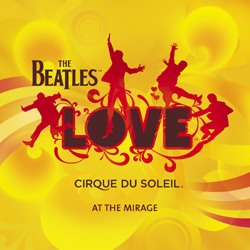
Love, the giant Beatles mash-up that soundtracks that latest Cirque Du Soleil extravaganza, is pretty damn awesome. Which is that least you expect from yer average Godhead. What's so good about it? Haven't we heard mash-ups before (the Grey Album, Revolved)? Sure, but none of those guys have had access to the original masters, and it's the fact that so many of the songs have been so beautifully remastered that's so cool - songs that had previously been mixed down onto an eight-track have had their constituent instruments split out and polished up, so now songs like I Am The Walrus and A Day In The Life sound reborn. A Day In The Life is especially wonderful. You can hear all the instruments in the symphonic freak-out, and the vocals after "I fell into a dream" are now startlingly clear. There's some kind of reggae breakdown in Hey Jude, with bass parts I've never heard before. As for the mash-ups, it all works astonishingly well, given how awful it could have been. Being For the Benefit Of My Kite rolls out on the psych noise of I Want You/She's So Heavy, Within Without You has been given Tomorrow Never Knows pummelling undercarriage, and there's a brand new string part written by George Martin for a demo of While My Guitar Gently Weeps.

It's all too good. I'm off to worship.

Monday, November 27, 2006

U2 Gone Poo


We went to see U2 the other day at the Telstra Dome. Man o man, but they were piss-poor. Who got in their ears and told them that the era 1990-97 was an aberration and should be quietly dropped from all future sets, and where can I find that person and set about ruining them in kind? Their last two albums have been stuffed full of highly polished, highly awful turds. Even the lead-off singles are doggish. Beautiful Day - ruined by football. Vertigo - please God spare us. What's worse is that the songs that they do play are now shamelessly slaved to Boon's messianic philanthropy, all the ambiguity removed so that now One is about Africa, With Or Without You is about, er, Africa probably and can you guess which continent could be described as a place Where The Streets Have No Name? Never mind that these songs might have meant something personal to you once. Bono was quoted the other day as wanting to go back and rewrite some of his early lyrics. I dread to imagine the damage he could do: "I Will Follow/Assuming you make a donation to charity". At one point- it's hard to recall this clearly as I fear I was at that moment trying to ingest my own sensory organs- Bono wore some sort of head-scarf with symbols of all the major monotheisms, and a touchingly simple logo: CO-EXIST. Of course! That's what we should do! Co-exist! Suddenly it seemed so simple. Although, can I be churlish for just a teensy moment and suggest that of all the bothersome people in the world that message should be directed to, a stadium full of U2 fans in Sydney would be fairly low on the list? And in other news; are you fucking kidding me? Where did all the irony go? What happened to the playfulness, the pisstaking? Did I miss a meeting? "All that dance stuff, and silly costumes and lemons and MacPhisto? That's all out. It wasn't playing well in Denver." There was a two-song salvo of the ways things were, when they played an encore of Zoo Station and The Fly. Even the big screens finally came to life. Up to that point, they had entertained merely slow-moving blobs of colour, which I suppose was at least fitting. Remember Bullet The Blue Sky, with the burning crosses which morph into swastikas? Can't have that! Too weird for the new post 9-11 U2. We can be the generation that ends poverty, Bono said over and over again. Is it too much to ask that U2 address their poverty of imagination first?

The very next day I went back and listened to POP, to see if maybe I had been kidding myself about its qualities. Not a bit of it. It sounds great. What's best is the quality of doubt that, again and again, can be read into Bono's lyrics. Please and Wake Up Dead Man are both pleading, questioning, confused, and are great. Last Night On Earth rocks harder than any of their later efforts, and the opening trio of songs punch hard to the solar plexus, wherever that is. Best of all though, I think, is Gone, where for once Bono seems to simply give up the preaching and retreat as if into a sensual bliss, aware that it's an abdication of his sloganeering self: "Goodbye/You can keep this suit of lights/I'll be up with sun/ I'm not coming down". An improvement on "A mole/living in a hole". And Please, while it deals with a similar subject as Sunday Bloody Sunday, is far more tortured, the cracked 'please' of the chorus an exhortation that knows it's falling on deaf ears.

All this, coming off a run of Achtung Baby, Zooropa and Passengers, were the U2 of awesome juxtapositions, of calling for pizzas and calling a beseiged Sarajevo. They embraced techno hip-hop and popular culture's dazzling contradictions and made music as big as before but this time with teeth. The worthy was always there, but the vehicle was sleek and sharp. Once they emerged from a lemon. Now they are the lemon.

Co-exist? Shove it up yer bum.